
Whether you're looking for a lamp for your living room or want to modernize your entire home with LED technology: sooner or later, you'll come across the specification "Lumen." But what exactly does that mean? In this post, we'll explain in simple and understandable terms what lumens mean, how they are measured, and why this value is crucial for your lighting planning.
What does Lumen (lm) mean?
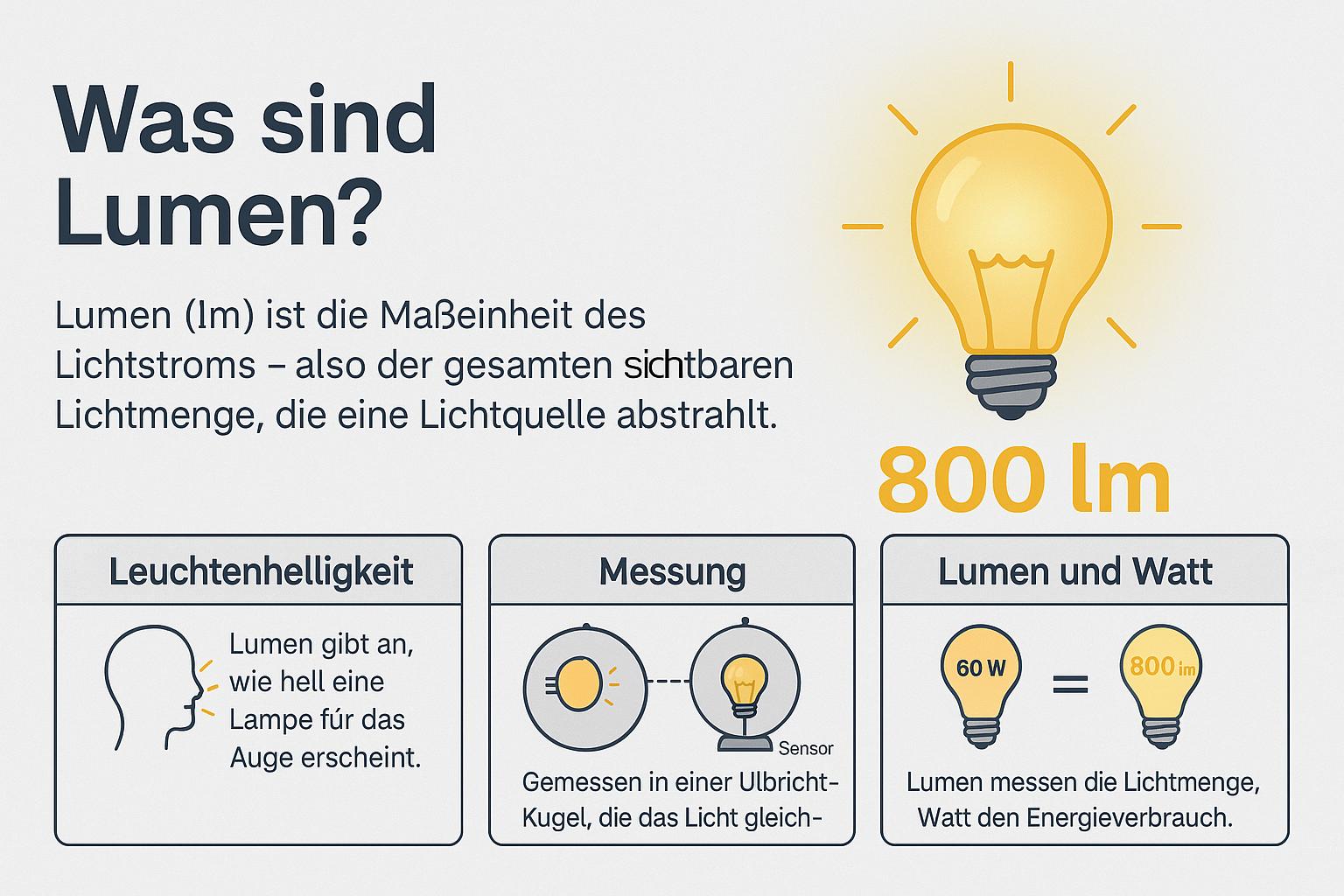
Lumen is the unit for what is known as luminous flux. Simply put: Lumen indicates how much visible light a light source emits in total. The more lumens, the brighter the light appears to our eyes.
What's special about lumens is that they only consider the part of the light that humans can actually see. Invisible radiation like UV or infrared light is not included.
Lumen is not the same as Watt
Previously, people used wattage (e.g., a 60-watt light bulb) to estimate brightness. However, this is no longer practical today, as modern light sources like LEDs are much more efficient.
For comparison:
-
A classic 60-watt incandescent bulb has approx. 700–800 lumens.
-
An LED with only 8 watts can provide the same brightness.
Watt = Power consumption
Lumen = Brightness
How are lumens measured?
Lumen measurement takes place in a special measuring device, usually a so-called integrating sphere. This measures all the light that a lamp emits in all directions. The value is given as "luminous flux" in lumens.
What do different Lumen values mean?
| Lumen Value | Approx. Equivalent | Typical Application |
|---|---|---|
| 100–200 lm | Night light, candlelight | Decorative lighting |
| 300–500 lm | Small desk lamp | Accent or supplementary lighting |
| 700–900 lm | 60-watt light bulb | General room lighting |
| 1000–1500 lm | Brighter ceiling lamp | Living room, kitchen, hallway |
| 2000+ lm | Very bright luminaire | Workshop, outdoor area |
Tip: Pay attention to "Lumen per Watt"
If you are looking for particularly efficient light sources, look for the lm/W (lumens per watt) specification. The higher the value, the more light you get per watt consumed.
Example:
-
An LED with 1000 lm at 10 watts has 100 lm/W = very efficient
Conclusion
Lumen is the most important specification when it comes to the actual brightness of a lamp. The higher the lumen value, the brighter the light source. When buying light sources, pay attention not only to watts but especially to lumens and lm/W. This way, you will find the perfect light for your purposes – whether for coziness in the living room or concentrated work in the office.
Want more lighting knowledge? In our next posts, we'll also explain "Kelvin" (light color) and "Candela" (light intensity).